
International Resin Modellers Association©SM®TM
SITE UPDATE! As Yahoo! Site Solutions is no longer being updated or maintained after today, Thursday 31 March 2022, IRMA will be moving to a new provider. This will take us some time, so please be patient. We will be listing kit release dates on our new site. Thank you for your patience and understanding.
International Resin Modellers Association ©SM®TM
Zane R Nobbs
405 Old Orchard Drive, 18
Essexville, MI 48732
United States
ph: 001-989-891-1401
fax: 001-989-891-1401
alt: 001-989-465-6241
info
Articles 47
The Orion III Space Clipper from 2001: A Space Odyssey
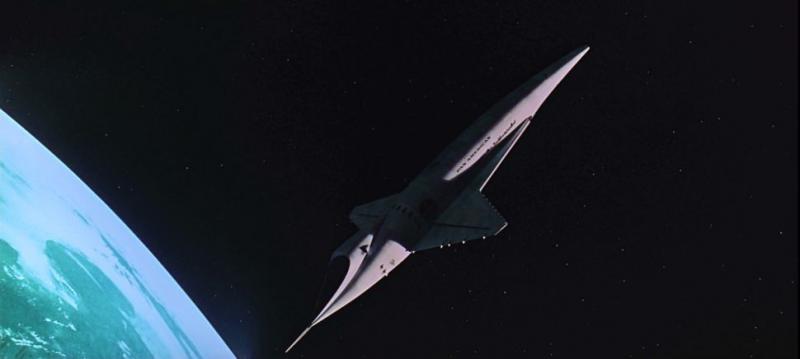
The Orion III Space Clipper en route to the Space Station V. Still from "2001: A Space Odyssey." Arthur C. Clarke.
Did you know that the engines theorized for this spacecraft could actually exist? While the books and movie advocate atomic engines, these have not developed to date, however, jet technology is making advances that could theoretically propell such an aircraft/spacecraft to the edge of Earth's atmosphere. One of these possibilities could consist of 2x General Electric GE90-115B axial flow turbofans for atmospheric flying and several Aerospike rocket engines for space flight.
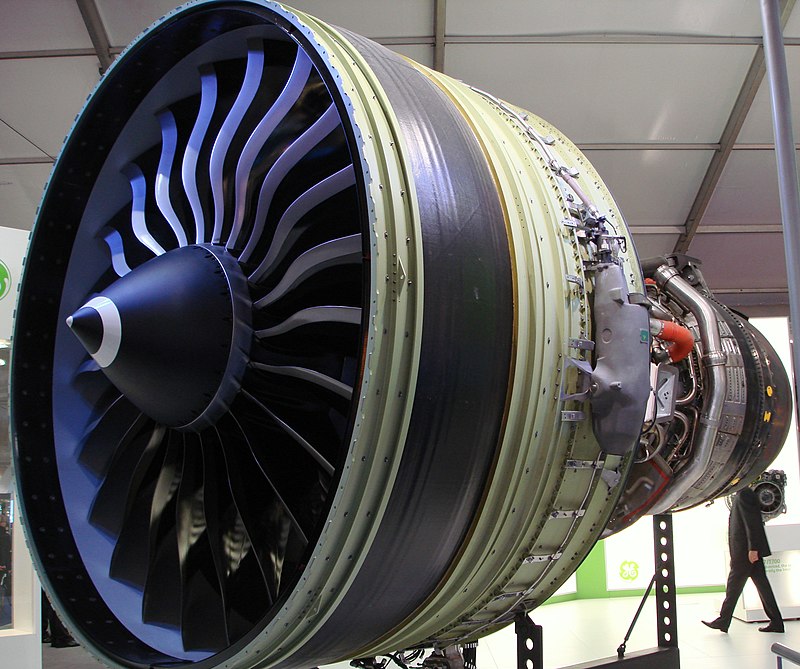
General Electric GE 90-115B axial-flow turbofan. Photo by Dysanovic.
The main Aerospike rocket engines are utilized to propell the Orion III toward Space Station V with several smaller rocket and chemical engines to help with adjustments in space, espcially upon approach to the space station. Rocket engines don't require oxygen as jet engines do, thus the jets are shut down while outside of Earth's atmosphere.
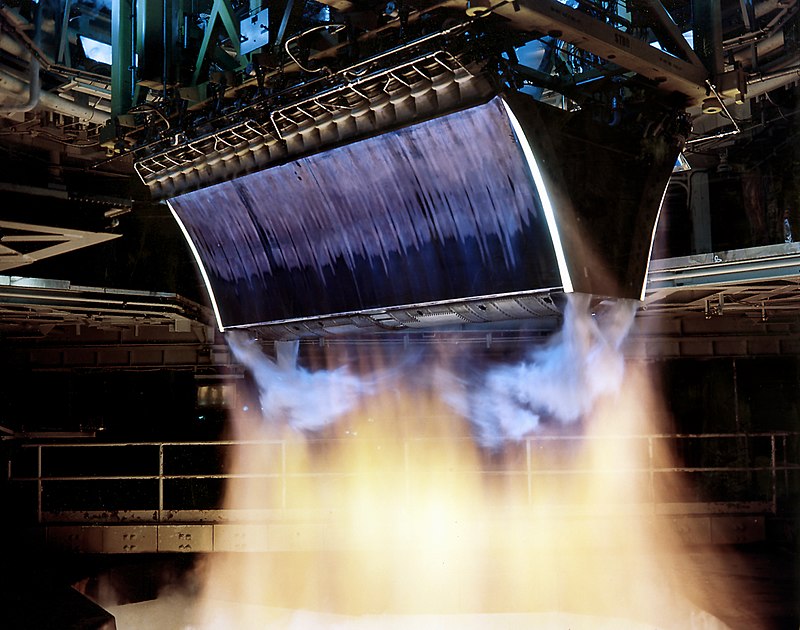
Rocketdyne Aerospike XRS-2200 twin rocket linear engine. Photo by NASA.
Some think the Orion III could still be a viable project, especially in that for the movie much of it is based on actual technology of the time and how it could be developed in the future. Many have stated that the Orion III could be a natural evolution of the German Sänger-Bredt Silbervogel (Silverbird) Amerika Bomber Project or the Fiesler F-103/V-1 Wotan from the 1940s.
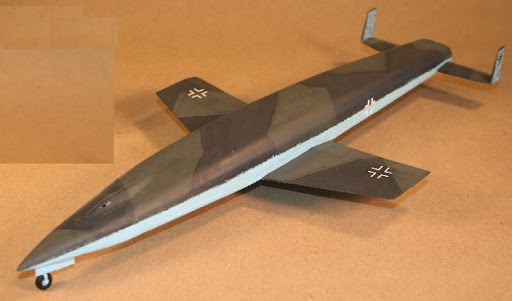
Sänger-Bredt Silbervogel in 1/72 by Sharkit. Model and photograph by Zane R Nobbs.
The Sänger-Bredt aircraft was designed by Eugene Sänger and Irene Brendt in the 1930s as a space plane before being weaponized by the National-Socialist regime of The Third Reich during WWII. Fortunately for the Allies, it only reached the very beginning of the mock-up stage.
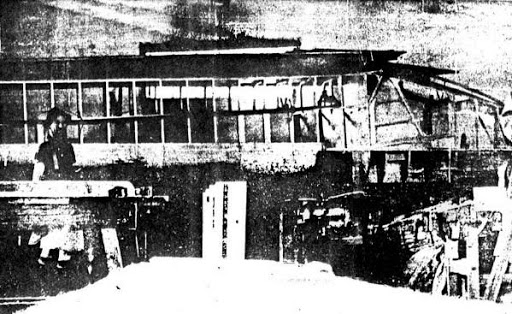
Sänger-Brent Silbervogel mock-up or construction. Luftwaffe archival photograph.
The Sänger-Brent aircraft would have taken off on a long rail pushed by an acceleration engine until launch speed permitted it to take off at the end of the slide. It would have then propelled to the outer edge of the Earth's atmosphere to "skip" in segments to the target. Of course we know today, that without a heat shield, it most likely would have burned up on reentry.
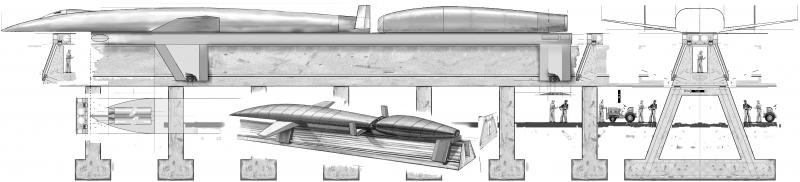
Sänger-Brent Silbervogel rocket sled. Illustration by Sharkit.
Although not being produced during the war, post-war the design fell into Soviet hands and was modified into the Keldysh Bomber using a similar setup with the addition to two ramjet engines on each wing. This too would have taken flight from a ramp propelled by a booster craft.
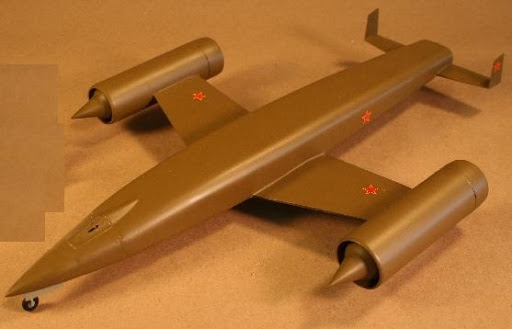
Keldysh Bomber Project in 1/72 by Sharkit. Model and photograph by Zane R Nobbs
An additional source of inspiration may also be from the Fiesler F-103/V-1 Wotan of WWII that was launched from a rail to gain enough speed to fly with it's Argus 014 pulsejet. This saved on landing gear or having to provide reusable gear with a more effcient system.
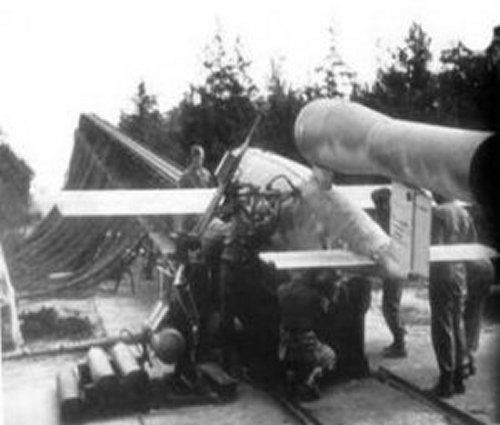
Fiesler F-103/V-1 Wotan on launch rail being readied for flight. Luftwaffe archive photo.
Indeed, there was also a manned version of the Wotan, the Fiesler F-103 Riechenberg. This version came late in the war and it's questionable if the pilot could successfully escape before letting the aircraft hit the target.
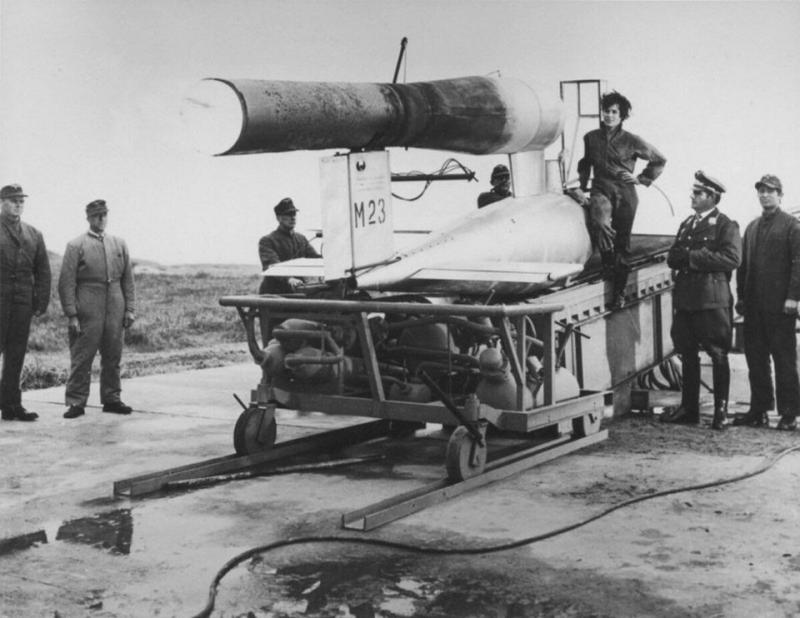
A Fiesler F-103 Reichenberg running up the engine with test pilot Hanna Reitsch. Luftwaffe archival photo.
Further inspiration came from Willy Lay, an academic on space and a popular science fiction and future enthusiast of the 1950s. Ultimatly, this led to the concept of Harry Lange for the Orion III Space Clipper.

An illustration for a movie add in 1968 in a foreign magazine showing the Orion III Space Clipper atop the Orion I Space Booster. The Orion II is a cargo version of the Orion III.
Some have speculated that were the Orion III Space Clipper to be built, it would launch from a separate craft beneath it to escape Earth's atmosphere.
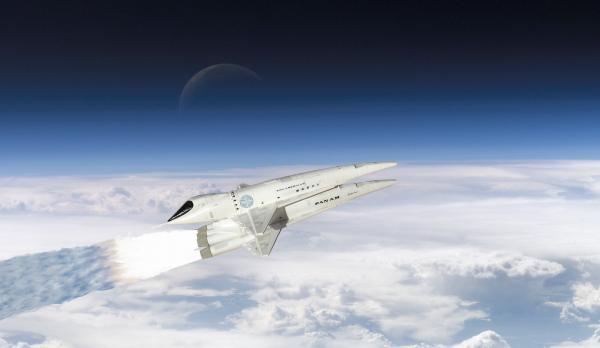
The Orion III Space Clipper ascending to space on the Orion I Booster Stage to Space Station V.
Illustration by Karl Tate, from 2001: The Lost Science, by Adam K. Johnson, Apogee, 2012 and
The 2001 File: Harry Lange and the Design of the Landmark Science Fiction Film, by Christopher Frayling, Reel Art Press 2015
In the world of 2001: A Space Odyssey, the Orion III Space Clipper involves a collaboration of several companies: Generl Electric for the jet engines, Rocketdyne for the rocket engines, IBM for the onboard computer, and one source suggests Grumman for construction of the Space Clipper itself. There may possibly have also been a level of international cooperation as well.

Orion III Space Clipper on approach to Space Station V. Still from "2001: A Space Odyssey." Arthur C. Clarke.
The movie "2001: A Space Odyssey" looked very feasible when it came out in 1968. A part of this consisted of those involved with the film consulting with NASA to design future vehicles along realistic lines. With such a scientific approach, many have found the film to be a major inspiration in the world's of science fiction as well as science fact. Even today this movie is listed as one of the greatest, and perhaps the greatest film of all time. Since 1968, humaity has gone to Luna (the moon) and soon to Mars along with sending probes into and outside our solar system, launched several space shuttles, and constructed space stations such as Skylab, Mir, Tiangong I, and Tiangong II. While things may not have evolved specifically as depcited in the movie, humanity is moving along at a slower pace, then again, the future is always more optimistic, especially when it is depicted 33 years from the present!
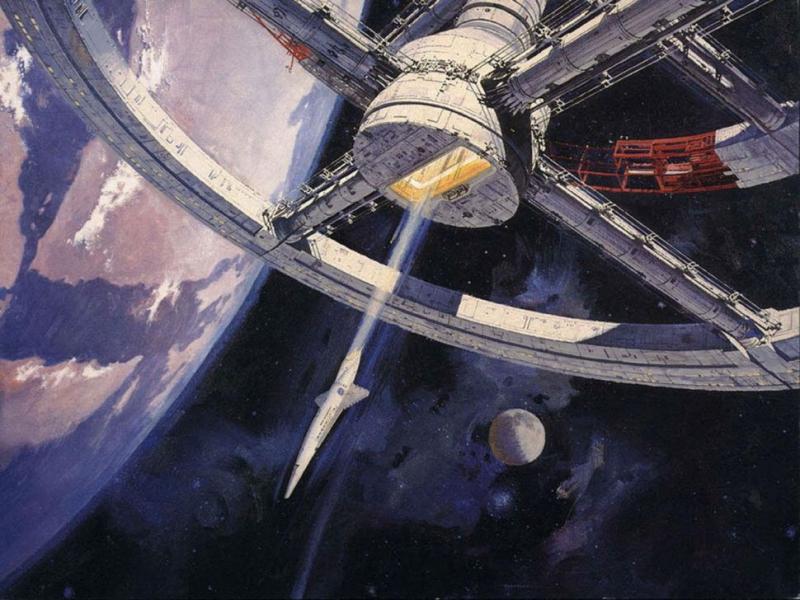
Orion III Space Clipper leaving Space Station V. Movie poster from painting by Robert McCall, courtesy of NASA,
Aircraft Specifications:
Engines: 2x General Electric GE90-115B axial flow turbofans (possibly) &
.......................2x Rocketdyne Aerospike XRS2000 rocket engines for space flight
Multiple small rocket & chemical engines for space manuvering
Length: 175 ft/53.34 meters
Wingspan: 85 ft/25.90 meters
Height: 23 ft/7.01 meters*
Weight: Unknown
Crew: 3-5, Pilot, Co-Pilot, Stewards
Seating: 20-32 passengers
Performance: Mach 14/10,742 mph/17,287 kph
*including landing gear as illustrated in 2001: The Lost Science, Volume 1, page 16
References for this Article:
2001: The Lost Science Volume I, by Adam K. Johnson, Apogee, 2012
2001: The Lost Science Volume II, by Adam K. Johnson, Apogee, 2016
The 2001 File: Harry Lange and the Design of the Landmark Science Fiction Film, by Sir Christopher Frayling, Reel Art Press 2015
2001: Filming the Future, by Piers Bizony, Aurum Pr Ltd, 2000
Fantastic Flight: The Orion III Spaceplane from "2001: A Space Odyssey," by Karl Tate, Space.com, 2016
Solving the Commercial Passenger Spaceflight Puzzle, by Mike Snead, TheSpaceReview.com, 2019
Ronpur's Space Models, by Ronpur50, Spaceflight.com, NASA, 2016
2001: A Space Odyssey, by Sir Aruthur C Clark, New American Library, 1968
2010: Odyssey Two, by Sir Arthur C Clark, Del Ray, 1982
2061: Odyssey Three, by Sir Arthur C Clark, Del Rey, 1988
3001: The Final Odyssey, by Sir Arthur C Clark, Del Ray, 1997
International Resin Modellers Association ©SM®TM
Zane R Nobbs
405 Old Orchard Drive, 18
Essexville, MI 48732
United States
ph: 001-989-891-1401
fax: 001-989-891-1401
alt: 001-989-465-6241
info